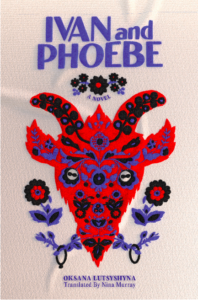
“Ivan and Phoebe” was written by acclaimed author, writer, poet, literary scholar, and translator Oskana Lutsysyna. Born on October 10th, 1974 in Uzhhorod, Ukraine she went on to get PhD in comparative literature from the University of Georgia. The book has won the Lviv City of Literature UNESCO Prize and Taras Shevchenko National Prize in fiction, some of the top literary awards in Ukraine. Through a feminist lens, Oskana Lutsyshyna’s book “Ivan and Phoebe” examines the impact of the Revolution on Granite on family life.
“Ivan and Phoebe” is split into three distinct sections spanning time and place. In the first section ‘The Gloaming’ the author explores how Ivan and Phoebe met, showcasing the intricate fractures in their relationship as they go from meet cute to marriage. In the second section ‘Revolution’ the author flashes back to Ivan’s time at the Revolution on Granite and how the event changed his outlook on and approach to life. The second section begins with a quote from a religious battle prayer setting the stage for the section’s revolutionary content and putting readers in Ivan’s mindset at the time. In the third section ‘The Choir’, Phoebe and Margita, Ivan’s mom, take center stage and stand up for themselves by pushing back against Ivan and the patriarchy he represents.
Ivan’s perspective dominates the book with less than 10 pages dedicated to Phoebe’s point of view. As such, Ivan’s biased narration impacts how the audience reads the story. Lutsyshyna is a woman writing a book from a man’s point of view and this narrative style allows the audience to empathize and relate to Phoebe, without reading much from her point of view. Since the book’s title implies equal narration by each spouse, this set-up reinforces the dominance of male voices and perspectives in our society. This pushes the audience to question larger narratives worldwide and to take note of who is telling these stories.
The importance of poetry to Phoebe as a character shows the bias of the author who is a poet herself. Phoebe finds poetry to be everything from an escape from her real life to a forum where she can relay her greatest frustrations. For Phoebe, poetry is central to her life and her sense of self. Phoebe’s first monologue is written in prose which stands in contrast to Ivan’s more traditional style of narration. This narration is much more negative than Ivan’s, eloquently implying Phoebe’s poor state of mind without ever saying it directly.
Readers may find themselves confused during the book’s occasional jumps through time. Without clear dates or a linear narrative the book can be difficult to follow since the distinction between memories and the present is blurred. Lutsyshyna uses this blurring to highlight the similarities between the past and the present, both in Ivan’s life and for Ukraine as a whole. However, the lack of a clear timeline may lead instead to misunderstandings over when various events occurred. Notably, historical references in the book are clearly dated, preventing a misunderstanding of Ukrainian history itself.
Lutsyshyna highlights Ukrainian history in the book from distant references to pre soviet times to the famous Revolution on Granite which is central to the story. In the light of Russian efforts to erase Ukrainian history the book stands out for showcasing the efforts of the youth protestors and their plight. A clear distinction is made between those who supported and those who opposed the revolution. This prevents a whitewashing of history by reminding the audience about who was willing to take a stand and who never left their seat. Since many of the people mentioned are real, to the delight of history buffs, the book acts as a historical text. The book teaches the audience about Ukrainian history and encourages them to learn more on their own. In the acknowledgments, the author specifically names various people who fought at the Revolution on Granite further linking the text to its historical roots.
“Ivan and Phoebe” contains many references to Ukrainian Culture. Oskana paints a realistic picture of life in Uzhhorod from niche references like restaurants in Uzhhorod like ‘The Urbino’ and ‘At the Uzh’ to the Uzh river itself. Fans of Yuri Andrukhovych will appreciate references to the Moscoviad through colorful characters like Sashko. The book also draws inspiration from famous Ukrainian feminist writer Oskana Zabuzhko.
“Ivan and Phoebe” is a book for fans of historical fiction, modern feminism, and Ukrainian history. Thanks to her personal experience, Lutsyshyna’s book provides a realistic depiction of life in Ukraine, especially in the rural western Ukrainian city of Uzhhorod and at the Revolution on Granite. Readers will leave with a greater appreciation for the role of protest in Ukrainian culture as well as a stronger understanding of Ukrainian culture in general. The book drives readers to question societal roles for men and women, and pushes them to ask who gets to tell history.
“Ivan and Phoebe” was originally published in Ukrainian by The Old Lion Publishing House in 2019. Then the book was translated by Nina Murray to English, and published by Deep Vellum Publishing in 2023. The book cover is intricate and full of symbolism with the wrinkles in the cloth creating a novel three dimensional effect. ‘Ivan and Phoebe’ can be purchased for $26.95.
Read the book: https://www.amazon.com/Ivan-Phoebe-Oksana-Lutsysyna/dp/1646052625
References
Lutsyshyna, O. (2023). Ivan and Phoebe (N. Murray, Trans.). Deep Vellum Publishing.
Lutsyshyna Oksana. (n.d.). PEN Ukraine. Retrieved October 25, 2023, from https://pen.org.ua/en/members/lutsyshyna-oksana
Oksana Lutsyshyna. (n.d.). Poetry Foundation. Retrieved October 25, 2023, from https://www.poetryfoundation.org/poets/oksana-lutsyshyna